Please note that this article was previously published in H2O’s Water matters
Cover photo courtesy: Raya Garden
Summary
When a stream valley landscape is designed to be climate-resilient, places are created where agricultural plots become wetter. These parcels of land would then require a different exploitation. Wet farming (paludiculture) can offer a solution where both farmer and nature benefit. Our research shows that many types of wet crops are suitable. Bulrush has the most potential to become a profitable crop because of its cultivation possibilities and growing sales market. New applications are constantly appearing on the market, such as processing into sustainable, peat-free potting soil. The business case for bulrush is not yet balanced. Cultivation becomes more profitable as the market matures and ecosystem services will be rewarded. How biodiversity can be enhanced with a smart landscape integration of wet crops is currently being researched. Thus, in the future, agriculture and nature can benefit even more from climate-resilient water and land planning. Climate proofing of stream valley landscapes creates places where agricultural plots become wetter. There is potential for cultivating wet crops on wet farmland to form a climate-resilient and ecological corridor between farmland and nature.
Introduction
Historically, large parts of the Netherlands were relatively wet. Originally, a lot of water was retained, especially in stream valleys and peatlands. Due to the straightening of streams and changes in landscape design, water-regulating ecosystem services have been lost in many places and drying-out is more common. In North Brabant, this drying-out is particularly visible on the high sandy soils of stream valley landscapes. Various projects are underway to make the landscape climate-resilient, whereby water is retained in an area for as long as possible. This will result in wet areas in a climate-resilient stream valley.
This new landscape design also requires other forms of agriculture and offers, for example, opportunities for wet agriculture and improving biodiversity and water quality. Wet agriculture (paludiculture) has so far mainly been studied in the peatland area. Not much is known yet about which climate-resilient business practices a landowner can apply in a stream valley landscape and what the consequences are for biodiversity.
The research group Innovative Entrepreneurship in Rural Areas of HAS University of Applied Sciences has investigated this in collaboration with farmers, the province of North Brabant, Radboud University and KWR Water Research Institute. The research question was posed: How can the land user switch to a different crop that contributes to climate-resilient land use and improvement of biodiversity? During the study, a combination of literature research, interviews, experimental research and balance calculations was carried out.
Types of crops
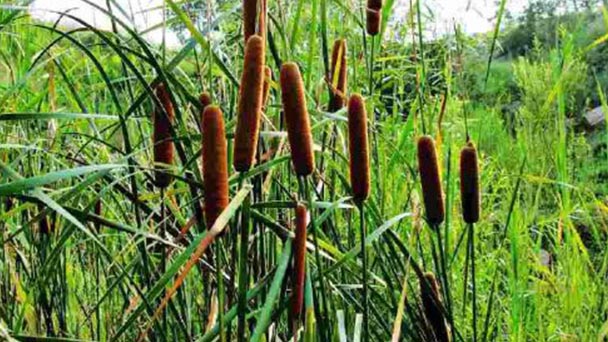
Bulrush has the most potential of the wet crops. It is a suitable crop for water retention areas (Veenweide innovation and knowledge centre, 2016). Wet agriculture is good for water quality. Bulrush, like reed, purifies surface water of phosphate and nitrogen (Geurts et al., 2017). However, reed evaporates more water compared to bulrush (Mueller et al., 2005) and may therefore be a less suitable crop to place in drought-prone locations. Woody crops such as willow and black alder can also be used, especially in areas that can be periodically dry (Geurts et al., 2019). Apart from the better known wet crops, there are also alternative crops grown in the greenhouses of HAS University of Applied Sciences, including cranberry, calamus and lakeshore bulrush. These crops grew well on peaty and sandy soils at different high groundwater levels, so they are potentially a good choice for wet farming.
Current status of sales markets
Van Duursen and Nieuwenhuijs conducted a market survey in 2016 for several wet crops, the market is not yet fully developed. Azolla (mosquito fern), bulrush and peat moss are the most promising crops to grow in peatland areas. In addition to the growing market for insulation material and fodder, bulrush pollen can also be used as food for predatory mites that are used for biological pest control. Research into new applications and sales markets is ongoing.
For wet agriculture in stream valley landscapes, azolla and peat moss seem less suitable. Azolla is an invasive exotic species and is therefore undesirable for introduction into stream valleys as a wet crop. Growing peat moss in stream valley landscapes will be a challenge due to the low acidity and trophic level that peat moss desires (Mettrop et al., 2020). These conditions are mainly found at (former) bog sites.
New sales market as potting soil
We investigated whether wet crops have the potential to be used as a sustainable substitute for fossil peat in order to create a new sales market. To explore this, a cultivation trial was conducted at Radboud University in collaboration with HAS students. The growth of cress was compared here on different potting soil mixtures (Figure 1).

Figure 1: Biomass of cress on substrates of wet crops (greenhouse test Radboud University)
In the trial, five wet crops were briefly composted and mixed with each other or with 100% fossil potting soil. Cress was sown on this and the germination and yield of cress were measured. The germination and survival of cress was lowest on the 100% fossil potting soil. Combinations of 50% fossil peat and 50% reed canary grass, peat moss or azolla produced more biomass than a peat substrate. Even substrates that consisted entirely of composted wet crops (peat moss and bulrush) achieved almost the same biomass as cress grown on 100% fossil peat. By further optimising the pre-treatment (chopping, composting and/or fermenting) and mixing of wet crops, yields will eventually improve. This will enable the creation of a sustainable sales market for wet crops. The benefits are two-fold: less fossil peat needs to be excavated, while drained peatlands are restored.
Operations
Balance calculations have been drawn up for bulrush in which crop-specific costs and benefits have been included (Table 1). It can be concluded that, under the present circumstances, the business case is not yet balanced and it is therefore not yet profitable for farmers to switch to wet agriculture. This is partly because the market for bulrush is in its infancy; farmers can use it mainly as roughage on their own farms. The market for bulrush as insulation material is growing. There are also efficiency gains to be made in harvesting.
In Scenario 1, if the market for insulation material/fibres increases or if it can be sold as sustainable potting soil, the yield of bulrush will increase. This can balance the business case (just barely) if the crops also become more efficient. If social services, such as water storage and carbon sequestration, are also included in the calculation at a rate of about €750 per hectare per year, the business case will improve significantly and there will be prospects for farmers to make the switch.
Table 1: Balance calculations of bulrush cultivation in the current situation; Scenario 1: payment for ecosystem services and development of chain; Scenario 2: use of land positions by authorities and development of chain.

1Fact sheet Bulrush Veenweide innovation centre, 220 ton*€120, 3based on harvested reed: Nature and Landscape Management 2019 grant 2020 from the BIJ12 website, 450% DM 10 ton* €38 CO2 ,5 The transport costs are €10,- per ton dry matter, 6: For a mechanised harvest, the costs are expected to be between €800 and €1100 (Van Duursen and Nieuwenhuijs, 2016).
There is also another route to a balanced business case. If authorities provide land positions that are challenging due to higher water levels, subsidence, water storage, wetlands or climate adaptation, and would make these available at a lower rent, a positive result can also be achieved (Scenario 2). In this way, this land can remain in production and authorities can achieve their goals in a more or less budget-neutral way. This would be a more favourable outcome for authorities than buying out companies. Although public money is needed for this, the alternative in such places is often that farmers are bought out or compensated for wet damage. The most cost-effective approach can be determined per area, whereby an important advantage of the transition to wet agriculture is that this land will ‘simply’ remain in production.
Landscaping and biodiversity
The large variety of wet crops also means that there is no single predictable effect of these crops on biodiversity. Especially in the buffer zones around nature areas, wet agriculture can enhance biodiversity. Wet crops can function as a corridor for target species, with the preference being for growing native crops (Van Duinen et al., 2018). Research in reed beds has shown that birds such as the red-backed shrike and the whinchat in particular use the reed beds for foraging or resting. Depending on the mowing regime, the biodiversity can be influenced. For example, most marsh birds benefit from a mosaic mowing regime, which means that parts of the reed are not harvested each year (Korevaar & Van der Werf, 2014). The question is to what extent biodiversity can benefit or whether wet agriculture actually encourages pests such as mosquitoes. This will probably depend on the location in the landscape, the water level and the mowing management. To answer this question, research is currently being carried out at various locations in North Brabant, investigating the impact of wet agriculture on biodiversity and how the landscape ecological fitting of wet agriculture in a stream valley can be shaped.
Conclusion
There is potential for cultivating wet crops on wet farmland to form a climate-resilient and ecological corridor between farmland and nature. Conditions for the earnings model of wet agriculture to be balanced are that the market develops further, ecosystem services are rewarded and/or land positions are used. We are currently investigating the opportunities that the landscaping offers to better connect nature and agriculture.
References
- Geurts J. M., van Duinen G.J., Van Belle J., Wichmann S., Wichtmann W., Fritz C. (2019) Recognize the high potential of paludiculture on rewetted peat soils to mitigate climate change. J Sustainable Organic Agric Syst: 69(1):5–8
- Geurts, J. M., Fritz, C., Lamers L., Grootjans A. P., Joosten H. (2017). Paludiculture keeps the polder clean – purifying surface water and mining phosphate-rich soils with reed and bulrush cultivation. H2O-online.
- Korevaar, H., & van der Werf, A. K. (2014). Reed cultivation as a possible building block for sustainable water and soil management in wet peatlands. Plant Research International Report 544. https://edepot.wur.nl/296257
- Van Duinen, G.J., Fritz, C., de Hullu, E. (2018). Perspectives for wet farming in the Veenland International Nature Park. Pilot project on paludiculture. Report Stichting Bargerveen
- Mettrop I. (2020) Better Wetter Phase 2, wet-culture trials. A&W report 3153-2 Altenburg & Wymenga ecological research, Feanwâlden
- Van Duursen J., Nieuwenhuis A. (2016) Market Exploration Paludiculture; Opportunities for Agriculture in Peatland Areas while Preserving Peat. https://www.innovatieprogrammaveen.nl/wp-content/uploads/2017/06/Marktverkenning-Paludicultuur_14-06-17.pdf
- Wichtmann, W., Schröder, C., Joosten, H. 2016. Paludiculture – productive use of wet peatlands. Stuttgart, Germany, Schweizerbart Science Publishers.