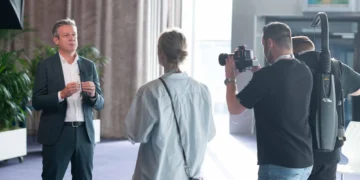
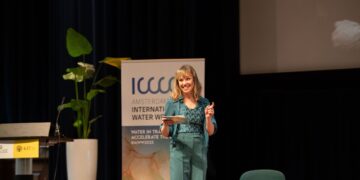
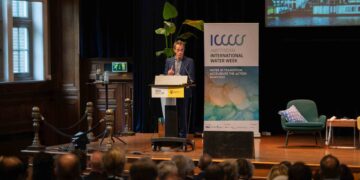
At AIWW2023, the wokshop Strategic Human Capital was held. Aim: dialogues and knowledge exchange of challenges and best-practices on Human Capital in the international water sector. Please find below the summary of this workshop for your benefit.
Organizers:
- Amsterdam International Water Week
- Royal Netherlands Water Association
- Wetskills Foundation
- World Water Academy
Participants:
Johan Oost (Wetskills Foundation, chair), Jelmer Klinkenberg (Netherlands Water Partnership – Young Expert Programmes), Kaspar Sonnemans (Ministry of Infrastructure and Water Resources / Human Capital programme of TopSector Water, NL), Gabrielle Knufman (World Water Academy), Ahmed Al Busaidi (Sultan Qaboos University), Savanna Kok (Ministry of Infrastructure and Water Management), Barbara Swart (Ministry of Infrastructure and Water Management), Duduzile Mtembu (Department of Water & Sanitation South Africa),, Ntabiseng Fundakubi (Department of Water & Sanitation South Africa), Teboho Nkhahle (Lesotho Highlands Water Commission, Susan Andrews (Department of Water & Sanitation South Africa), Robert Haslam, Oscar Alvarado (The Hague Academy for local governance), Bram Ooms (World Water Academy), Ronald Hemel (Waterprof), Naomi Timmer (European Junior Water Programme), Peter Jansen (World Waternet), Monique Bekkenutte (Royal Netherlands Water Association), Solee van Roon (Netherlands Water Partnership – Young Eexpert Programmes), Theresa Fute (Department of Water & Sanitation South Africa, Wetskills participant), Oftense (Department of Water & Sanitation South Africa , Wetskills participant), Maria Cristina Pasi (IZAR), Eva Beton, Letizia Bochi, Oriana Jovanovic, TU Delft, Claudia Peters (World Water Academy, summary)
Opening
Johan welcomes the participants and opens the workshop. This Strategic Human Capital Workshop is the first step to discuss and promote this important subject in the international water sector. We hope to conduct workshops around this topic during the World Water Forum in Bali in 2024 and the WISA Conference in South Africa in 2024. The focus of this workshop is on inflow, mobility and outflow, so from student life to retirement. We focus on the Human Capital challenges and solutions in the whole world and have an interactive group work part at the end of the programme.
Introduction: Strategic Human Capital, By Kaspar Sonnemans
The Netherlands changed in the last four years. Four years ago I started as a trainee of Rijkswaterstaat. There were 150 potential trainees for 1 vacancy. Currently our challenge in the Netherlands is to attract people and keep them engaged in the water sector. Climate change causes human capital challenges. We have lots of transition challenges so we need a workforce that is sufficiently large to tackle these challenges. We need more inflow in the water sector, we currently have lot of vacancies and the workforce is aging. People working in the water sector need other skills and competences. Innovation is entering the water sector, like AI and the use of robots. Some questions that arise:
- What human challenges are needed to succeed in our green and blue transitions?
- How to innovate live long learning for Water and Maritime?
- How to better involve mbo (TVET) students in Water and Maritime?
Several questions were asked after Kaspars presentation.
- Does Kaspar have a clue how many people we need in the water sector?
The current goal is to at least keep the water sector at its current size, so for every person flowing out there should be a new person entering. - How is it possible that there isn’t a problem in the energy sector?
It seems that we took the situation a little but for granted. The energy sector can seem more interesting for potential employees due to their new kid on the block image.
Pitches about Global Human Capital challenges
Susan Andrews from the South African Department of Water and Sanitation gives a presentation about the challenges in South Africa. Susan shares her insights on how to become an attractive sector. The department uses bursaries for students at high school, works with personal development plans and pays attention to continuous professional development. A challenge in South Africa is that when you train people in the water sector, especially women, they will end up going to the private sector. In South Africa young water professionals find it difficult to get permanent employment. A question we have to ask ourselves is how to create an intergenerational dialogue.
Naomi Timmer from H2O People tells about the challenges in Europe, based on a white paper from the working group towards a water smart society. A major challenge is that we don’t have any numbers of employees working in the water sector. Unfortunately we don’t exchange the knowledge we have in the different European countries. Therefore, what we need is human connections. People get to know each other and sit together in meetings, but how do we bring the cooperation further? We don’t know how to find the people that we need, how to train them and how to share knowledge. The reason is that we don’t have the time. But because of this, we end up losing people.
Ahmed Al Busaidi from Sultan Qaboos University gives a presentation about the challenges in Oman. In Oman, the situation is different: we have to use water from treatment plants as drinking water. We have to convince the people that the water is good for farming. It is very difficult to do so. As to human capital, there have been several editions of Wetskills in Oman. Main challenges are to integrate support between all scientists in organizations and to support networking between scientists and researchers.
Peter Jansen from World Waternet ends with pitching the challenges that we have in the Dutch Water Sector. One of the challenges is the image of the water sector, young employees stay only a short time, and there is competition between the different organizations in the water sector. We also face some European challenges. Laws and legislation are very different in the different countries. That makes exchange of knowledge and employees difficult. It is stated by law in the Netherlands that 1% of the finances should be used for the development of the personnel. Other countries would like to have the same but it is difficult to realize. Peter also works in Laos and shares some of his experiences from working there. Capacity building often leads to losing the trained employees to other organizations and can also form a risk for the organization. We want to cooperate, but see other organizations as competitors instead of cooperators and this is something we should work on.
Round of questions
- Question to Susan: does she pay everything for the students?
Everything is paid by the government. It takes about 10 years to become an engineer in South Africa. So we have to start early in recruit new people. We give the new people the possibility to gain experience. - Question to Ahmed: where are the students going after graduation?
Most of them stay in the water sector. - Question to Naomi and Peter. In theory we can learn a lot from other European countries. What are the most important difficulties to overcome, and what can we do as the Dutch government?
Step over the idea that we already know everything. We are often considered arrogant, and we have to realize that we can learn a lot from other countries. The financial and legal structure is very different from other countries. The ministry can assist in this.
Best practices of Human Capital in the water sector
Some best practices of Human Capital in the water sector were shown in short pitches.
- Ronald tells about Waterhandjes. They bring students and clients together in water related projects.
- Johan explains the concept of Wetskills. Young professionals and students from different countries work together in Wetskills projects.
- Naomi tells about the European Junior Water Programme and Blue innovation track. A company that supports impact and innovation through a human connection by young professionals from the sector (2 – 10 years of working experience). The Blue Innovation track creates InterVision sessions for professionals in whole Europe.
- Jelmer talks about the Young Expert Programme (YEP). Focus is on young professionals (with a maximum of 4 years of working experience).
- Maria Cristina. The water sector is the sector of localization. Every country and region has his own legislation, water sources and problems.
- Gabrielle gives a presentation about Wateropleidingen in The Netherlands, and World Water Academy internationally. The focus is on life-long learning for water professionals by offering interactive and practical training courses and tailored training programmes. It is important to keep your knowledge up-to-date.
- Monique explains about the Royal Dutch Water Association. Brings together people from the whole Dutch water sector to change experiences. Provides a platform for lifelong informal learning. Building a community is key for all the challenges and solutions.
Research on human capital by Oriana from TU Delft
Oriana is doing research on human capital. Young water professionals are doing this research together to keep young people in the sector. The sector is still very traditional. She made a survey for the water professional to assess what skills water professionals need to have tomorrow. What do we need to do to be successful in the sector being young? And what kind of programs do we have to support young professionals in the sector? The survey will be launched in different countries, please scan the QR code and share it in your networks.
Discussion in 4 groups
After hearing the challenges and the possible solutions, it was time for the discussion. The participants were divided in four groups and discussed about the following questions:
What are the main challenges in inflow/mobility/outflow and what are possible solutions? Each group presented their challenges and solutions.
Presentation inflow group
Challenges:
- Lack of people, less people make overprizing an issue. We are currently fishing in the same pond
- Lack of data, how many people do we have, how many people do we need, we don’t know
- Retention of skills
- Learn from outside the water sector
Solutions:
- Mindshift to an open minded culture, we need diversity in people, also we need to focus more on soft skills, currently we mostly have engineers
- Put water knowledge in the curriculum. Visit a dike, a water board during secondary school
- More community engagement with sectors that need water expertise
Presentation mobility group
Two challenges:
- Losing people to other sectors or companies within the sector, how to keep the people engaged and keep people learning?
- How to create water leaders and not only specialists to be able to tackle the complex challenges that we are facing?
Solutions:
- Providing our employees with development options (for example through life-long learning or stimulating internal job hopping) allowing them to grow as professionals while staying at their organizations, hereby creating new water leaders (by creating a learning culture)
- Boost international exposure to enrich the perspectives that we have in order to successfully deal with the challenges that we face
Presentation outflow group 1
Challenges:
- Image problem of the water sector
- People leaving to other companies
- People retiring
Solutions:
- More opportunities for training
- Mentorships
- Competitions (like Wetskills)
- Internships
- Relationship within the team and between employees and supervisors
- Diversity is a key for success
- We need more fresh minds and a retirement program
Presentation outflow group 2
- Main problem is the brain drain that occurs as a result of the outflow
Solutions:
- Rebranding the sector
- Professional development of a diverse group of people and actively involving other sectors
- Mentoring new employees
- Forming a community for water skills development sector-wide
Closure of the workshop
Johan closes the meeting by asking the participants to share their take aways.
- Bram: Peters idea of working together as a community for the whole sector instead of as individual organizations.
- Monique: provide mentorship inside and outside the companies.
- Ahmed: mixed program to learn from each other.
- Jelmer: continue the knowledge sharing.
- Duduzile: expose our youth.
- Solee: integrating the young professionals into the sector can be the solution for many problems.
- Susan: young people are the future, we should listen to them.
- Teboho: how to create water leaders rather than water professionals.
- Oriana, lots of organizations want to help the young water professionals, they should realize there are ways to help them.
- Gabrielle: we have to keep an open mind and the sense of community we feel right now, we should embrace it.
- Maria: likes to see facilitation tours for the young generation, to get their position. Give the young people the possibility to take their opportunities.
- Barbara: we already knew that keeping young people into the water sector is very important. There are lots of initiatives. There is so much we can do together.
- Peter: we need data, and we all have our own responsibility in bringing the topic back to our organizations and practice what we preach.
- Savanna: also focus on other sectors, because water is the base of the others. We can learn from each other.
- Kaspar: international aspects. Inspiring to hear those stories. We should empower human capital.
- Ntabiseng: South Africa empowering and developing each other, win win situations.
Everybody is very passionate about the topic. There will be follow-up meetings. Let’s keep in touch!