The effort required to meet the requirements of the Water Framework Directive (e.g. far-reaching phosphorus removal) and the increasing focus on the removal of pharmaceuticals call for technologies that serve both purposes. The PAC + cloth filtration technology offers this solution. At the Vinkel waste water treatment plant, this technology was investigated for the first time in the Netherlands. Within the STOWA (Foundation for Applied Water Research) Innovation Programme Micropollutant Removal from Wastewater, a pilot study was successfully carried out under the supervision of six water authorities.
The removal of micropollutants such as pharmaceuticals from wastewater is a hot topic that many water authoritiesare working on. A promising technology is the combination of powdered activated carbon (PAC) with cloth filtration. This PAC + cloth filtration technology has already been successfully applied in some wastewater treatment plants in Germany. Powdered activated carbon, metallic salt and polyelectrolyte (PE) are added to the effluent. This binds pharmaceuticals and phosphorus. Sedimentation and cloth filtration remove the bound compounds from the water.
Based on the experience in Germany, Royal HaskoningDHV carried out a feasibility study into the technology within the STOWA Innovation Programme Micropollutant Removal from Wastewater (IPMV) in 2018 (STOWA 2020-21). This showed that the technology is also promising for Dutch wastewater practice. In the IPMV it was therefore decided to give the green light for further research on a pilot scale in the Netherlands. The pilot study was carried out by the Aa and Meuse water authority, ELIQUO and Royal HaskoningDHV under the supervision of STOWA, the Ministry of Infrastructure and Water Management and six water authorities that financed the pilot study.
The technology
The technology focuses on the further treatment of the WWTP effluent, at the end of the active sludge process. PAC (5-15 mg/L) and metal salt (3-10 mol Fe/mol P) are added in the post-treatment PAC + cloth filtration step. Pharmaceuticals bind to the PAC and phosphate binds to the metallic salt. The sludge that is formed is separated from the water by means of a settling and cloth filtration step, which requires the addition of a small amount of PE (0.3 – 0.5 mg/L). The clean water can then be discharged; the sludge must be disposed via the regular sludge disposal or as a separate waste stream.
Similar to other activated carbon technologies, pharmaceuticals are removed from wastewater by adsorption using activated carbon. By varying the PAC dosage, the type of PAC, the PAC concentration in the contact tank and the PAC residence time in the system, the removal efficiency was adjusted and the process optimised. Metal salt is dosed as a coagulant to bind phosphate and for the coagulation of PAC. For the latter, the dosage of PE is additionally required.
Separation of the sludge (mixture of PAC, metal salt and PE) and water takes place in a two-stage separation configuration. In the first step, the bulk of the sludge is settled in a lamella separator by gravitational separation. The settled sludge is largely returned to the contact tank. A small part of the settled sludge is discharged as surplus. In the second step, the remaining sludge, which is still present in the sedimentation step, is separated by cloth filtration. The cloth filter is cleaned periodically to remove the captured sludge. This flow is returned to the contact tank or discharged as surplus sludge.
Design of the pilot study
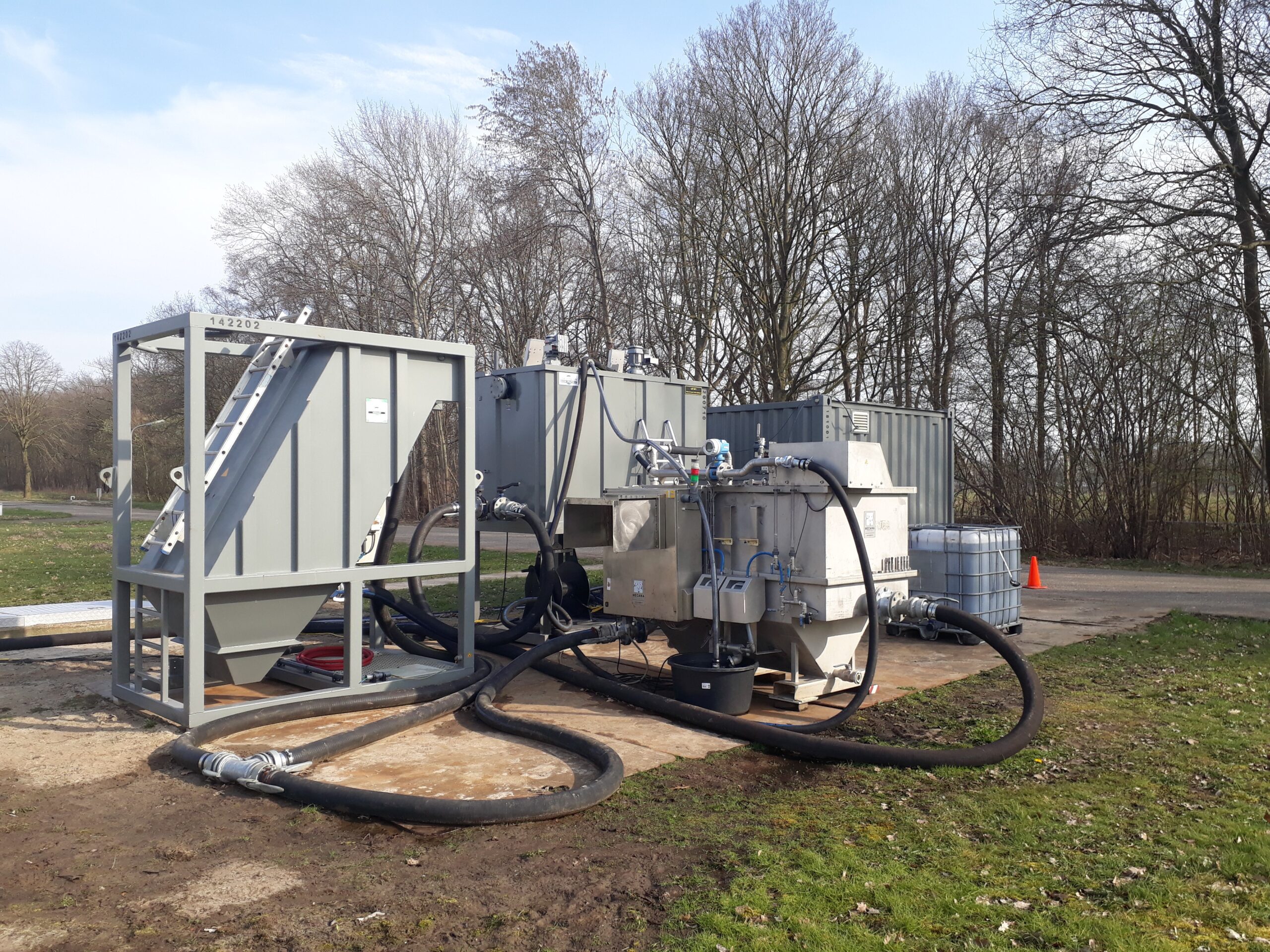
The pilot study was carried out between March and August 2021 at the Vinkel WWTP of the Aa and Meuse water authority. The pilot plant was not a one-on-one copy of the technology already proven in Germany. An alternative configuration was chosen with a lamella separator instead of a traditional sedimentation tank with the aim of a smaller space requirement, more flexibility in the design and realisation and possibly also a cost saving.
It is known from Germany that the configuration with a traditional sedimentation tank is capable of both good removal of pharmaceuticals (approx. 80%) as well as a low total phosphorus concentration (approx. 0.1 mg/L). However, this has not been investigated in the Netherlands before. The central research question of the pilot study was therefore: Is it possible to use a single technology on a Dutch WWTP to remove both pharmaceuticals and phosphorus to a large extent using lamella separation as the sedimentation step? A second research question was whether the technology works without dosing PE.
In the pilot plant, 1 to 5 m3/hour of WWTP effluent was treated, which is only a small portion of the total effluent of the Vinkel WWTP with an average flow of 600 m3/hr. The installation was set up outside and consisted of the process steps: 1) contact tank, 2) lamella separator and 3) cloth filter (Figure 2). During the first months, a stable operating mode was sought in which a good effluent quality was achieved (concentration of total suspended solids <10 mg/L). In particular, the influence of the sludge concentration in the contact tank on the settling and filtration process and the influence of PAC, metal salt and PE on this process were investigated. The main outcome is that dosage of PE is needed. Without PE, the settling of the sludge mixture of PAC and metal salt is moderate, which hinders proper separation. By dosing a small amount of PE (0.3 – 0.5 mg/L), the sedimentation rate increases significantly, resulting in a very high separation efficiency of >99.9%. With this knowledge applied, the process was run for 2 months without making any major changes to the pilot settings. In this stable period, the most important research results have been obtained.
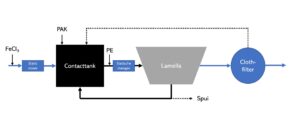
Figure 2: Schematic diagram of the pilot plant
Results of the pilot study
The investigated configuration of the PAC + cloth filtration technology worked well: good sludge separation took place, pharmaceuticals were well removed and low concentrations of total phosphorus were achieved. In the lamella separator the bulk (>99%) of the sludge was separated, in the cloth filter the last sludge particles were removed (to <3 NTU).
The results with regard to the improvement of water quality (pharmaceuticals and phosphorus) are very positive. Far-reaching removal of pharmaceuticals has been achieved with a relatively low PAC dosage. At PAC doses of 5, 10 and 15 mg/L, removal efficiencies of 67, 92 and 95%, respectively, were achieved on average for 7 of the 11 guide substances (see Figure 3).
The national target for pharmaceutical removal is a 70% removal efficiency of 7 of the 11 guidance substances over the entire WWTP (STOWA IPMV and Ministry of I&W contribution regulation). Taking into account the removal efficiency of the activated sludge process itself (approx. 30%) and the capacity of a post-treatment technology that is usually 1.5 times the dry weather flow (by-pass for storm weather flow), a PAC dosage of 8 mg/L is sufficient. Compared to the best available PAC technology, Powdered Activated Carbon in Activated Sludge (PACAS), which doses approximately 15 mg PAC/L, the PAC dosage of the PAC + cloth filtration and the associated CO2 footprint of PAC + cloth filtration is almost halved.
In addition to the removal of pharmaceuticals, the reduction of ecotoxicity was also investigated. A battery of biological effect measurements with in vivo and in vitro bioassays (various CALUX tests, the Daphnia Immobilisation test and the Microtox test) has shown that the effects measured in the various tests have decreased by more than 50%, and have dropped below alert values (i.e. after PAC + cloth filtration technology the water is no longer toxic).
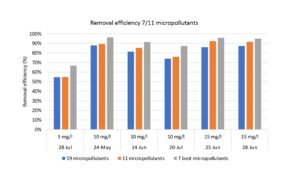
Figure 3: Average removal efficiency of pharmaceuticals over the 6 measuring days (date) at different PAC dosages (mg/L).
Phosphorus
Phosphorus has also been successfully removed to a large extent. Over the period of two months of stable operation, the concentration of total phosphorus in the wastewater effluent was reduced from an average of 0.96 mg/L to 0.18 mg/L. During a two-week period of very stable operation, an average total phosphorus concentration of less than 0.1 mg/L was achieved, with sampling days of less than 0.05 mg/L on individual measuring days. With these low concentrations of total phosphorus, the WFD requirements for total phosphorus in surface water of 0.15 mg/L are met. The metal salt dosage required to achieve this translated into a ratio of 4 to 9 moles of iron per mole of phosphorus (molar ratio Fe:P).
Zoomed in into the different fractions of which total phosphorus is derived, the largest removal is visible in the ortho-phosphate fraction. This fraction, with an average concentration of 0.81 mg/L, accounts for approximately 85% of the incoming phosphorus and was largely removed to an average concentration of 0.05 mg/L. It is noteworthy that the organicdissolved phosphorus fraction, which is usually very difficult to remove, was also largely removed.
The concentration in the wastewater effluent of this fraction of 0.09 mg/L was reduced to 0.02 mg/L on average. This removal is thought to result from the presence of PAC to which the organic dissolved phosphorus binds. The main phosphorus fraction in the pilot plant’s run-off is the metal-bound phosphorus. These are (very) fine particles that did not coagulate into larger flocs and therefore pass the settling and filtration step. Optimisation of the coagulation process can further reduce these emissions on a practical scale, so that (even) less metal-bound phosphorus is released. A more detailed description of the pilot tests (set-up, implementation and results) is currently being set out in a STOWA report. It is expected to be published at the end of Q2 2022.
Relevance to practice
The results of the pilot study are positive; a high level of removal of pharmaceuticals and a low concentration of phosphorus were achieved. The pilot scheme showed that with the PAC + cloth filtration technology it is possible to remove pharmaceuticals and phosphorus from wastewater in a single treatment step. The results of the pilot study therefore pave the way for application of the technology on a practical scale. The performance of the technology and the points of attention for its operation and management have been made clear by the pilot study. This allows us to move on to full-scale realisation. Application on a practical scale fits in seamlessly with the current tasks in the water cycle. The far-reaching removal of phosphorous (WFD requirement) and pharmaceuticals (Ministry of I&W incentive scheme) are high on the agenda of many water authorities.
Authors: Karin Bertens Zorzano, Devon Dekkers, Bart Verberkt (Aa and Meuse Water Authority), Tonke van der Pol (ELIQUO), Xian Riedijk and Arnoud de Wilt (Royal HaskoningDHV)
Reference list:
STOWA 2020-21 Feasibility study PAC + cloth filtration