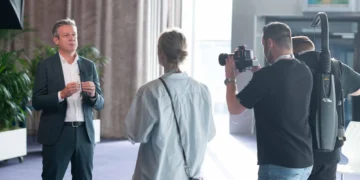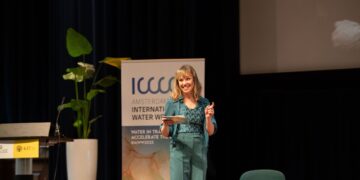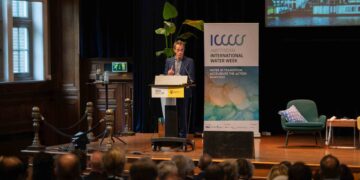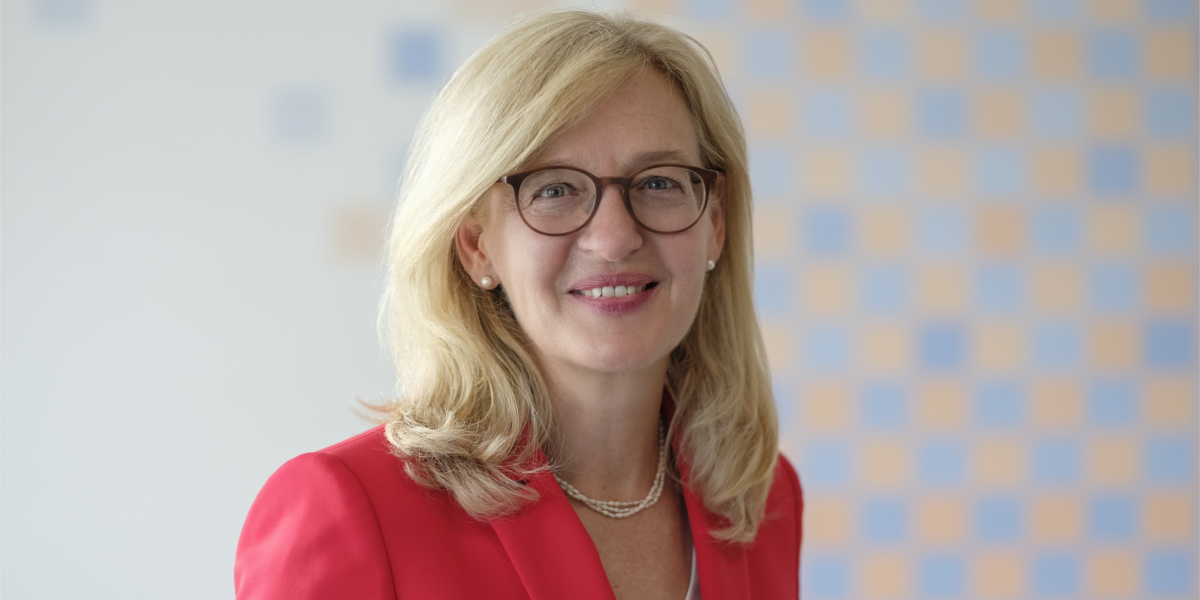
Dr. Claudia Castell-Exner is President at EurEau and Head of water management, water quality and water usage as well as Director European Water at DVGW. She joined the AIWW community in 2019, as a panellist for AIWW2019 and workshop host. Here, she shares her approach and perspective on the importance to protecting drinking water.
With a background in Physical Geography Claudia Castell-Exner basically could have picked any environmental sector to work in. She chose water. “In the eighties I had the opportunity to participate in a collaborative project between farmers and the local water supplier. I took soil samples and analysed the nitrate level, so we could guide farmers on how much was actually needed to optimise crop growth. We needed to analyse the soil carefully, since nitrate surpluses were affecting the local drinking water resources. This was my first contact with water, in a professional way, and I just found it fascinating to see the delicate balance between human activity and nature. I was hooked from that experience.”
“Everyday has its own challenges”
“In fact, I took this study as a basis for my thesis. I started working at DVGW – the German technical and scientific association – after I finished my studies, and basically never left.
Through DVGW, I had the opportunity to work on European policies, advocating for stronger water legislation that robustly protects people and planet. My work has never been boring. Everyday has its own challenges. There is so much to learn, to analyse, to initiate; the possibilities are endless.”
Tough discussions
In Claudia’s work her overall goal is to prevent drinking water resources from being contaminated by hazardous substances stemming from farming, industry or other activities that use water. “As long as drinking water resources are well protected, we can supply drinking water without extensive or costly treatments. Water professionals are perfectly capable of treating raw water with incredible techniques, but let’s be honest, we all want our tap water to as untreated as possible. The best way to do is keep our resources protected from possible contaminants.”
In order to protect water, Claudia is in continuous dialogue with industries such as pesticides and pharmaceuticals. “Dialogue is the best approach to understand, understand their concerns and reasoning but equally to convey our interests. The discussions can be really tough, but there are lighthouse projects.”
Collaborations – some examples
One of these projects is a collaboration between a water supplier, the farmers in a drinking water catchment area and bakers in Bavaria. It involves the farmers reducing the amount of fertiliser to the bare minimum which is of benefit for drinking water resources. The bread that is baked using this wheat gets a special label: ‘Water Protection Bread.’ Customers know they will pay a little extra for this ‘green’ bread, but they are willing to do so. Farmers, bakers, customers: they’re in this together which is a win-win for everyone. And very good for the protection of drinking water resources.
Another good example is the support of water suppliers for farmers to change their farming practices to organic farming, which goes much further into protecting our water resources. In return for their proactivity in reducing their use of synthetic pesticides and fertilisers, water suppliers compensate the farmers for the extra costs of this organic farming.
We also share good practices and learn from each other. For instance, we are working with pesticides producers. We established a roundtable in 2007 in Germany gathering big players like Bayer, BASF and Syngenta and meet them on a regular basis. We developed a data base on pesticides findings in drinking water resources and we use this to look for solutions for the individual cases of pesticide contamination in the catchment area. During the roundtables the producers inform us of their developments in plant protection products. By working together, we are establishing collaboration and trust, even if we have diverging views or interests. So, being open minded and looking forward are rewarding characteristics. It’s game changing!”
Persuade with practice
Claudia has proven her approach to be successful many times. What is the secret of your success? “In EurEau, we believe in working together, based on sound experience. We are a reliable partner to our peers. They know we will give them clear and trusted information about the reality and day to day practice of supplying almost 500 million people with clean affordable and safe water. When we talk about water issues, we know what we’re talking about. We know the practice.
What happens on EU level?
We work very closely with the EU institutions to ensure we have robust EU level legislation that adequately protects each of us and our environment for years to come. We are delighted with the European Green Deal, its strategies and plans with their clear objectives. There is momentum to change and protect the environment we depend on. Maybe not everyone is on the same page yet, but that is a matter of time. Some people will respond primarily, like in a reflex, “It is too big! It is too far!” But we all know now is time to move and make a well protected environment a reality. I can assure you, at the moment the Commission is igniting fireworks, and we are overwhelmed with roadmaps, plans, strategies and evaluation reports. But we can see the goal and we are ready to discuss, to engage and to deliver.”
Zero Pollution ambition
“When it comes to the zero pollution ambition, we have a clear view. The first insights of the plan – which will come in spring 2021 – were disappointing since there was a strong focus on addressing the overall goal only by monitoring and digitalisation. We are working with the Commission to change this, and we have high expectations. This is the opportunity for the Commission to apply existing EU-principles such as the Precautionary and Polluter Pays Principles. Furthermore, producers should take responsibility for the entire cycle of hazardous substances they place on the market, something else that is possible under the Zero Pollution ambition. Safe and affordable drinking water is essential for life. We all depend on a reliable supply of drinking water for our homes, workplaces and society in order to function. Why should we, as consumers society, have to bear all the costs for treating water? That is not fair, obviously. So the Polluter Pays Principle need to be in place – otherwise it is the whole society who pays.”
Exchange of knowledge
Long before the current pandemic, but optimised at the moment, Claudia knows how to share knowledge, long-distance. “There are so many ways to exchange knowledge in an effective way. It can be via an opinion piece, written in a magazine or on a website. Or via a presentation in which we share our perspectives. Decision papers. Blogs. Draft amendments for a legislative file. Proposals, podcasts, peer workshops and yes, in online meetings … we share our experience in any form, describing what is needed, what are the key figures, how you can organise something. The key is to make sure it is relevant and interesting.“
Risk & Resilience
“I am impressed by this year’s AIWW themes, especially the subtheme Risk & Resilience. This is also an important issue we are discussing in EurEau and with our partners. Like many, we are facing risks like floods, droughts and pandemics. Spotlights are on the treatment of drinking water and waste water. To enhance these and be even more resilient is of upmost relevance. But our sector needs funds and investments. We have to raise awareness that if we want to guarantee robust and resilient water services, we need the necessary funds to plan, build, operate and maintain the necessary infrastructure. Especially in small municipalities water service providers are struggling to set – according to the Cost Recovery Principle – appropriate tariffs, taxes or transfers they need to fulfil their tasks since this is very often a political issue.
About Dr. Claudia Castell-Exner
Dr. Claudia Castell-Exner is President at EurEau and Head of water management, water quality and water usage as well as Director European Water Head of water management at DVGW. “Water is one of the elixirs of life – and it has always fascinated me. I had the chance to boost my affinity for it during my studies of geography when I had the opportunity to work on a collaboration project between a drinking water utility and winegrowers to provide approaches that were designed to apply water resources protective farming practices (1987).
After my graduation and PhD I joined the DVGW (German Technical and Scientific Association on Gas and Water) in 1991 – a step that reflects my intense interest in water.
“The safe, efficient and reliable supply of water services is the basis of any society. Its professional organisation and sustainable development for future generations as well as the identification of future challenges and far-sighted actions are ambitious aims that serve as permanent yardsticks and guidance for me.”