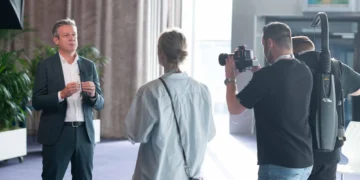
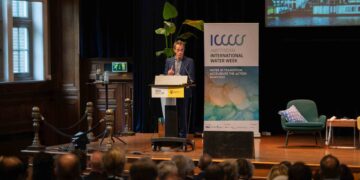
Gertjan Medema is principal microbiologist at KWR, part-time professor of Water & Health at Delft University of Technology, and Visiting Professor at Michigan State University. At the AIWW Focus Event, Gertjan talks about wastewater as an information source to fight a pandemic and the game changer for Water Utilities to wastewater monitoring as an early warning system.
Could you tell us more on your wastewater monitoring research?
“The last couple of months we had our heads in the sewers, to look for the new coronavirus, because we see that sewers can be early warning information carriers for this virus. We can find traces of the virus in wastewater and we can see whether this concentration in wastewater is going up or going down, and we see that this is mirroring what happens in society with the virus. If we see an increase in the wastewater, then there will be an increase in the cases by the local health reports.”
Has monitoring from wastewater being used before?
“This type of monitoring is really new for this new virus. Wastewater monitoring has been conducted for other viruses, like polio, and also for antimicrobial resistance illicit drugs and pharmaceuticals, so we really see that there is a paradigm shift from wastewater being waste towastewater being information carrier for society, reflecting what happens in society in pharmaceutical use or in illicit drug use, but also in circulation of this new virus.”
How did this monitoring come about?
“Like everything with this virus, the monitoring developed really rapid. There was no method for this virus until late January, when the method was developed in clinical labs. We had concentration methods for other viruses and we were quick to combine these concentration methods with the method from clinical labs to look for this virus. Then we started with monitoring in February, when the coronavirus was not yet present in our country and through our wastewater we saw the virus enter into our country. Now, in the second wave, we can localize in which cities or city areas the virus resurfaces.”
So even before the general public was under lockdown you knew that this was on its way?
“We saw the virus emerging in the city of Amersfoort six days before the first case was reported to the health authorities. This was the same for other cities. That is an indication about the early warning that you can get from this method.”
How is this information shared?
“This information is public information. Privacy issues are not so sensitive here, because we monitor wastewater on a city level or a large city region and you can’t pinpoint exactly who is infected. It is more an early warning for the municipal health officials to guide testing to the most affected areas.”
Is there anything that you would like to share with this particular community, about the potential? To use this at the national or European level?
“I see there is great potential for using wastewater as an information source. I told you about the illicit drugs use, but it is much wider than that. You can look at all kinds of biomarkers of things that happen in our society. We can look at infectious diseases, like COVID-19, polio and other virus diseases and how antimicrobial resistance is developing in our cities. We now learn to value what we use to call wastewater as a rich information source. We can make use of detection technologies that have emerged over the past decades. The COVID-19 example shows how these can be quickly deployed to look in wastewater and to use it as a tool to see what is going on in our society.
Wastewater monitoring is really an objective way to look at what happens in the overall community. Not everybody shows up at the test site for Covid-19, not everybody will report that they use pharmaceutical or illicit drugs, but everybody goes to the toilet.”
What are you excited about, when you think about 2030, what possible technology could be in place to be effective in flagging trends and tackling monitoring pandemics?
“Up to now the water sector has been improving monitoring of wastewater. At every plant there is monitoring availableto look at operational performance of the wastewater treatment system. What Ienvision is that this will be complemented with additional on-site monitoring systems that are probing our wastewater and warn us if something is going on with a new virus, with microbial resistance, or with illicit drugs or exposure to toxic chemicals. That list of markers that we monitor and understand what they mean in society is growing and growing, so I see a probing tool, a sentinel to look at the health of our cities.”
Are there specific bodies or organizations that can help you?
“The Amsterdam International Water Week is about bringing different stakeholders around water together and I think that is what we see and need here. Water is in the realm of the water utilities and sewers in the realm of the cities and health in the realm of health authorities. To make wastewater monitoring useful for public health and governance, these parties need to be brought together toto see the mutual interests and benefits and join forces to create this public health observatory for our cities.”
What are your obstacles?
“It is a challenge to get all these wastewater samples being taken and processed. It would be very nice if we could develop technology for on-site monitoring to have on-line information immediately available about what is happening in our cities.”

About Gertjan Medema
Gertjan Medema is principal microbiologist at KWR, part-time professor of Water & Health at Delft University of Technology, and Visiting Professor at Michigan State University. His research focuses on understanding the transmission of infectious diseases and antimicrobial resistance via water systems, and how this can be prevented through technical and non-technical management measures. His research forms the scientific basis for the design of safe water systems. He advises the World Health Organization on the microbial safety of water, and the European Union on drinking water and water reuse guidelines.